Join us for the summer project showcase (October 29th, 2pm, Foley’s at Notre Dame Stadium; RSVP here)
For companies

Can AI solve your operational challenges?

Most of our projects start with executives saying “that process is highly manual” or “we have the data, but struggle to convert it into intelligence.” iNDustry Labs’ executive advisors can help you choose the right project and staff it for successful solution prototyping.

Company Consultation

How it works

Join for a Spring, Summer, or Fall sprint.

  1. 1

    Consultation

    Give us your priority challenges. We will tell you whether AI or another technology can potentially solve it.

  2. 2

    Scoping

    We write a statement of work with objectives, activities, timeline, and resources. You pick an executive champion and day-to-day support team.

  3. 3

    Build

    Two to three fellows execute the project, with an iNDustry Labs project coach clearing blockers and our AI Engineers supporting the heaviest builds.

  4. 4

    Handoff

    A live demo, a documentation package and a proof of concept working system, at a minimum. Your IT and Ops team take over and get training on how to use it.

Project portfolio for your inspiration

Filtered by business function rather than industry, the same bottleneck tends to look similar across sectors.

Complete Spring 2026
General Stamping & Metalworks

Ask the shop floor a question in plain English

A text-to-SQL agent over PLEX ERP and Paperless Parts data, with a benchmark framework built to catch hallucinated joins before a plant manager ever sees a wrong number.

Aaron Afemikhe, Sean Patnett
Complete Summer 2026
CP Industries

A three-agent system for federal bids

Government quoting demands ITAR, NSN, and ASTM compliance across hundreds of line items. One agent parses the RFQ, one sources qualified suppliers, one scores what comes back.

Thomas Maldonado, Lesley Ekisowe, Christopher Qian
Complete Summer 2026
Lippert

Consolidating 1,043 job codes without breaking compliance

Twelve thousand employees across a thousand job codes, each carrying SOC, EEO-1, FLSA, and Workers' Comp metadata that cannot be lost in a merge, plus an agent that maps new roles to the consolidated set.

Marc Kawkabani, Tyler Budhu, Maureen Tremblay
Complete Summer 2026
CTS Corporation

A drafting co-pilot that knows house convention

Auto-generating 2D drawings from 3D models inside Solid Edge, capturing the datum-handling rules that live in senior engineers' heads rather than in any documentation.

Shane McAnuff, Ozi Akukwe, Akshat Mathur
Complete Summer 2026
CTS Corporation

Specification synthesis engineers can actually trust

A retrieval agent across SAE, IEEE, internal, and customer specs, built with strict citation rigor, because an engineer who cannot verify a clause reference will not use the tool twice.

Ryan Dolan, Christopher Qian, Katelyn Dong
Complete Summer 2026
Manufacturing Technology, Inc.

Turning legacy 2D drawings into editable 3D models

A pipeline that reads decades of engineering drawings and rebuilds them as parametric SOLIDWORKS feature trees, preserving the original design intent rather than just the geometry.

Batyrkhan Alimzhanov, Andrew Severino, Joseph Mathew
In progress Spring 2026
Vista Manufacturing

Finding the blockers on the critical path

A prioritization agent wired into Microsoft Planner that surfaces critical-path tasks and path blockers, so leadership attention follows the schedule rather than whoever asked most recently.

Kiki Petrovic, Thomas Maldonado, Kendelle Hung Ino
In progress Spring 2026
Manufacturing Technology, Inc.

Qualifying inbound leads before a human sees them

An agent that validates webform leads against web research and prior interaction history, then routes qualified ones into Sugar CRM along with the NDA exchange workflow.

Marc Kawkabani, Ty Purrenhage
Complete Summer 2026
University of Notre Dame HR

Answering the question candidates actually have

Candidates decline offers because they don't know enough about the region to say yes. A cost-of-living comparator and benefits view built to be shared during active recruiting.

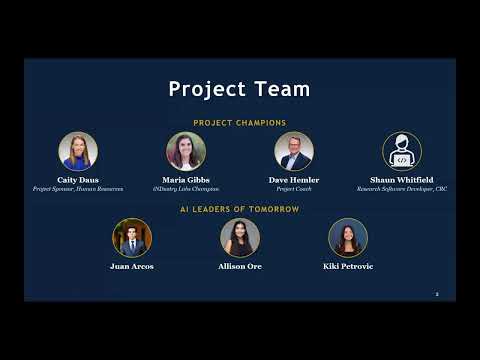
Allison Ore, Juan Arcos, Kiki Petrovic
Complete Summer 2026
C&S Machine

Taking routine questions off the HR team

Employees were going straight to HR for routine policy and benefit questions. A self-service agent in Copilot Studio answers from C&S’s own SharePoint documentation, deployed to Teams and SharePoint, with live escalation to a person when it cannot help.

PLACEHOLDER: fellow team to confirm
Complete Summer 2026
Beacon Health System

An HR assistant that knows when not to answer

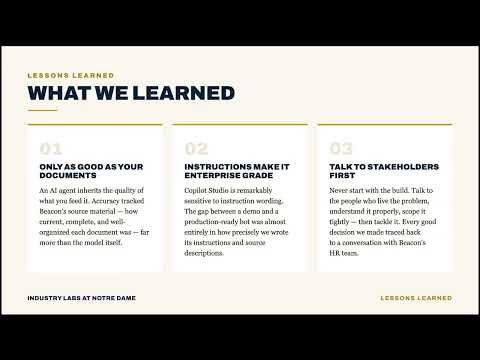
Beacon associates were hunting for HR information spread across SharePoint sites, PDFs and internal pages. Ask Rudy answers from Beacon’s own curated documentation, and routes anything sensitive or benefits related to the right team instead of guessing.

PLACEHOLDER: fellow team to confirm
Complete Summer 2026
Liftco

Rebuilding a storefront so buyers stop phoning in

Specs, fitment and warranty detail were missing from product pages, so dealers rang the office instead. The team rebuilt the site on a structured product catalog and added a chatbot that declines to answer rather than guess when it is not confident.

Karina McMahon, Anuj Chopra, Ty Purrenhage
Complete Summer 2026
Daman Products

Sequencing jobs to reduce tool swaps

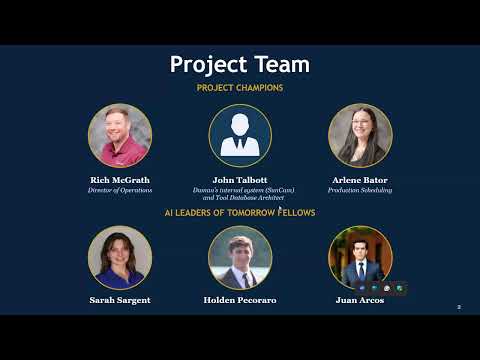
Machinists were changing tools in and out between nearly every job. An optimiser reorders the schedule and picks which tools each job should use, so the machine can run for hours without a changeover.

Sarah Sargent, Holden Pecoraro, Juan Arcos
Complete Spring 2026
General Stamping & Metalworks

HR answers in five languages, cited every time

Part of the workforce does not read English fluently, so written policy never reached everyone. A retrieval agent answers in English, Spanish, Pashto, Dari and Bosnian, cites the document and page for every answer, and sends anyone it cannot help to a person.

Melany Morales
Complete Spring 2026
General Stamping & Metalworks

Closing the books inside Excel, not around it

Trial balance exports, sign conventions and hundreds of cross-linked formulas made every month-end close a rebuild. The team pulled ERP data straight into Excel and packaged the mapping and variance logic as reusable skills the finance team can run themselves.

Joy Chen, AJ Meyers, Mark Imburgia, Tom Delany, Liam Fuller, Jimmy Liu
Complete Spring 2026
Kem Krest

Working out what can honestly be forecast

Seventy-six accessory SKUs carry millions in revenue and almost none behave smoothly. Rather than force a model onto everything, the team classified each item and reported plainly that roughly a third cannot be forecast without visibility into the OEM schedule.

Shane Bateman
Complete Spring 2026
Hoosier Crane

One dashboard instead of six systems

Apprentice progress lived across six disconnected systems with no single source of truth and no real-time view. A dashboard now pulls field reports, training scores and hours together automatically, replicating the tracking logic that had been maintained by hand in Excel.

Joe Kolar
Scoping a project

What makes a good student project.

Not every good business problem makes a good student project. These are the questions we work through together, and they are meant to open up possibilities rather than rule things out.

The problem

What is the challenge, and what would success look like? The more useful question is usually why it has not been solved yet.

  • The technology was not ready
  • Cost, time or skills got in the way
  • Data quality or access blocked it
  • It was never anyone's priority

The data

Fellows cannot build against a system they cannot see. What exists matters more than whether it is tidy.

  • Structured data in databases or a warehouse
  • Unstructured text: documents, PDFs, emails, policies
  • Examples of good and bad results

Your expert on the problem, not the solution

The most valuable person understands the problem deeply. They do not need to know what should be built. That is the project.

  • One expert, a small group, or knowledge spread across teams
  • Weekly check-ins of an hour is the usual rhythm

What happens after

Worth deciding early, because it shapes the scope.

  • Your team takes it over and scales it
  • It informs a future vendor or platform decision
  • It stands as a reference build
The model

How a project team is built.

Four roles on every engagement. The combination is what makes this different from an internship.

Company champion

The client. A president, CEO, or VP who owns the engagement and can unblock data access in days rather than weeks.

Project coach

The engagement manager from iNDustry Labs. Sets cadence, facilitates check-ins, owns scope conversations with the champion.

Fellow team

Two to three students who do the work, all trained by our professional staff around best problem solving and AI practices.

AI Engineers

Technical experts from Notre Dame's Data, AI, and Computing initiative back the heaviest builds and ensure safe cyber practices.

AI blog

Interested in what AI can bring to you?

Recaps and project news from the AI Leaders of Tomorrow fellowship and the iNDustry Labs team.

Showcase

Summer 2026 final presentations

Teams presenting their working software to the partner company and the cohort. Four recordings available so far.

On the projects section

All AI updates →

Questions

What companies ask.

Scope & commitment

What does it cost?

Projects are currently free of charge per iNDustry Labs' mission of developing a more productive region and the University's objective of providing world class applied AI skill for students.

How much of my team's time does this take?

A standing weekly call with the champion plus a day-to-day contact. The heaviest lift is front-loaded: getting fellows access to the systems and data they need.

What happens after twelve weeks?

You get a live demo, a documentation package and a proof of concept working system, at a minimum. Our team will check in with you periodically after the project to ensure the solution has been sustained.

Is this consulting?

No. This is an educational fellowship inside a university. Projects are chosen partly for what they teach. The output is real, but the purpose is students.

Data, IP & confidentiality

Who sees our data?

We provide an NDA template that ensures your data is safe. No one outside of our team sees your data without your explicit permission.

Will you publish our name?

Abstracted presentations, without any proprietary data, are shared with you prior to publishing on this website or any other media. Being part of the AILOT program automatically enrolls your company into the regional AI Executive Group where knowledge sharing among peers accelerates learning.

Who owns what gets built?

We work in your environment and the working solution stays yours. We retain the right to use the transferable skills we developed on the project across other engagements.

What kinds of problems fit?

Repetitive knowledge work with a clear input and output: quoting, document conversion, lead qualification, or querying a system that currently requires a specialist. If someone does it the same or similar way fifty times a week, it is worth a conversation.

Start here

Book 45 minutes with our executive advisors

Trouble with the embed? Open the scheduler in a new tab.